
By Cliff Calcutt, CEO, Agilebase.
Spend enough time in business circles and you could be forgiven for thinking there is only one definition of success.
Raise investment -> scale quickly -> sell the company -> repeat.
Attend startup events, read technology news or browse LinkedIn and you’ll see a steady stream of stories celebrating funding rounds, acquisitions and rapid growth.
The message is subtle but persistent: if you’re not pursuing investment, you’re somehow thinking too small.
But I have found the reality to be rather different. Most successful businesses will never raise venture capital, and I believe most shouldn’t.
That’s not because they lack ambition. It’s because venture capital was never designed to support most businesses in the first place.
The problem with success stories
We are naturally drawn to exceptional stories. We hear about the startup that raised millions and became a household name. We celebrate the founder who built a company and sold it for an extraordinary sum. These stories are exciting because they’re rare.
What we don’t hear about nearly as often are the thousands of businesses quietly creating and delivering value every day.
The engineering company employing 50 people, the professional services firm generating consistent profits year after year, the manufacturer serving a specialist market, or the software business solving a specific operational challenge for its customers. These businesses rarely make headlines, yet collectively they represent the overwhelming majority of successful organisations and contribute enormously to the economy.
It’s a little like asking children what they want to be when they grow up. Many will say footballer, influencer or pop star because those careers are highly visible and widely celebrated. Very few will ultimately follow those paths, but that doesn’t mean they won’t go on to build rewarding, successful careers in other fields. It simply means they are measuring success against the most visible examples rather than the most likely outcomes.
Business can suffer from the same delusion.
Venture capital has different objectives
One of the biggest misconceptions among founders is that investors and business owners are pursuing the same goal.
I’ve found that in reality, in the UK, they often aren’t.
A venture capital fund isn’t trying to build hundreds of steady, profitable companies. It’s looking for a very small number of extraordinary winners because the economics of the model depend on it. If an investor backs ten businesses and one becomes worth hundreds of millions, that single success can outweigh multiple failures. From the investor’s perspective, the model works exactly as intended.
For the businesses involved, however, the journey can be very different. The pressure to scale rapidly often changes decision-making in fundamental ways. Hiring accelerates, costs increase and growth targets become more aggressive. The organisation starts optimising for future valuation rather than current resilience. Sometimes that creates remarkable success, but just as often it introduces vulnerabilities that make the business more fragile than it appears from the outside.
Growth isn’t the same as strength
Many businesses assume that growth automatically makes them stronger, but unfortunately, growth tends to do the opposite.
Growth exposes weaknesses. Poor processes become more visible, communication becomes harder, customer service becomes inconsistent and operational complexity increases. Problems that were manageable with ten employees can become serious challenges with fifty, and issues that once seemed minor can quickly affect the entire organisation.
This is one reason why some businesses struggle despite strong demand. They have successfully built momentum but haven’t built the foundations required to support it. When investment is available, those weaknesses can sometimes be hidden for a while because additional funding allows businesses to hire around problems rather than solve them directly. Eventually, however, the fundamentals matter. Every organisation reaches a point where operational discipline becomes more important than growth itself.
The forgotten majority
The good news is that most businesses don’t need to become the next global technology giant.
In fact, many of the most valuable businesses occupy specialist positions that larger competitors overlook. They serve specific customers exceptionally well, understand their market deeply, grow steadily, invest carefully and build long-term relationships. Most importantly, they incrementally develop systems and processes that allow them to operate efficiently as they expand, creating a strong foundation for sustainable success.
These companies may never dominate an entire market, and they don’t need to. They create value for customers, opportunities for employees and returns for owners. Their success comes not from chasing headlines but from consistently delivering results over time.
THAT IS SUCCESS!
A different approach to building businesses
There is nothing wrong with pursuing investment if it genuinely aligns with your objectives.
But funding should be a tool, not a destination and too many founders start by asking:
“How do I raise investment?”
A better question is:
“How do I build a business that creates sustainable value?”
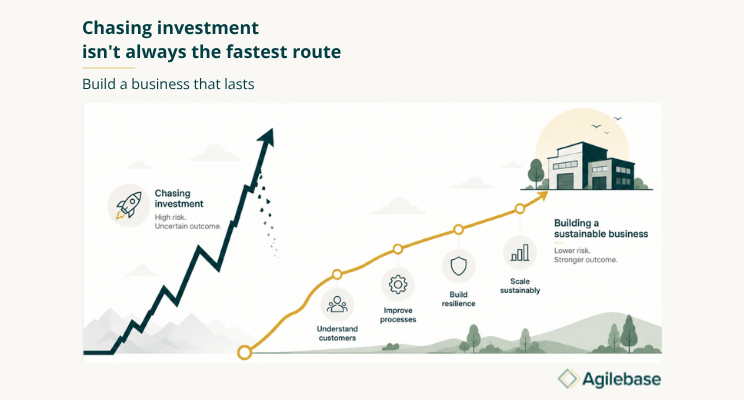
The answer usually involves understanding customers, developing repeatable processes, building operational resilience and maintaining control over growth. These activities may not attract the same attention as a major funding announcement, but they are often the factors that determine whether a business succeeds over the long term.
It’s less glamorous than the startup headlines, but it’s also how many of the world’s most enduring businesses were built.
Building for the long term
At Agilebase, we’ve always believed businesses should be able to shape their own future, when they are ready, rather than depend on external forces to do it for them.
That means giving organisations greater ownership of their processes, their timelines, greater visibility of their operations and greater flexibility as they grow.
We believe that long-term success is rarely about chasing the latest trend. It’s about building a business that can thrive regardless of what happens next. Having a back-office system that can be implemented incrementally as your business changes, grows, expands and truly maps to your unique requirements can be the difference between success and failure.
The most successful companies aren’t always the ones growing fastest. Often, they’re the ones still standing decades later.